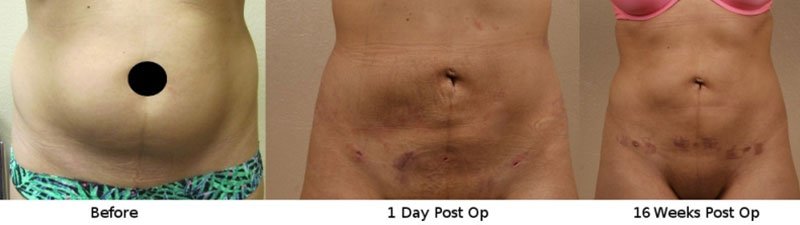
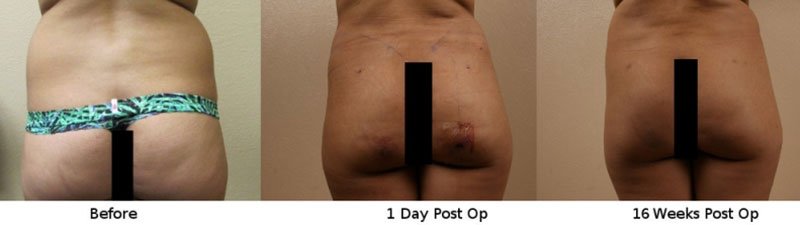
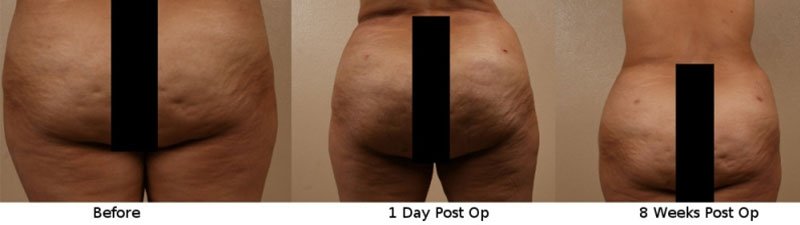
| CLICK PICTURES TO SEE A LARGER VERSION AND DETAILS! |
![]() |
![]() |
Would you like the shape of your body improved? Are you going through menopause or are you post-menopausal and find that just looking at food seems to add bulges to your figure? Do you have areas that you just can not seem to be able to reduce even when you are at or near your ideal weight?
The concept of removing fat through small incisions is not a rocket scientist concept. In fact the ancients tried this on many occasions. They always eventually ended up with a disaster due to sepsis, bleeding and/or perforations of the abdominal wall.
When we heard about fat being removed in this manner in France during the late 1970's and early 1980's we thought they were crazy and for sure they were going to have one disaster after another. But the reports were all positive.
I attended the first liposuction symposium sponsored by the American Society of Plastic Surgeons in the continental USA in January, 1983. The main presenter was Dr. Ilouz of Paris, France, who is considered to be the father of liposuction. I was not sure that I was not wasting my time and money going to this meeting. Then when the meeting was about at its midpoint Dr. Illouz performed liposuction of a woman's abdomen that had enough laxity that some loose skin had to be excised. A lower abdominal incision was made and the loose tissue was excised. The flap was elevated with retractors and the TV cameras were positioned to look into the wound created by the liposuction. What I saw was exactly what he had been describing. There was a honey comb of connective tissue extending from the deep fascia up to subcutaneous fat below the skin. At that point I became a believer. The fat was simply bluntly avulsed by suction from the connective tissue stroma.
During the meeting I arranged with Dr. Ilouz to visit and study with him. He trained me to do this procedure in Paris. I returned from Paris in March, 1983 with my French suction machine, tubing and canulae. I made the front page of the Odessa American with the caption, "New Way to Vacuum Fat". By the way, at that same meeting in January another presenter was from Switzerland, Dr. Kessler, who advocated using a cannula which disrupted the connective tissue fibers that run from the underlying muscle fascia (connective tissue that covers the muscles). You don't hear anything about Dr. Kessler's approach now because just about everyone believes that leaving as many of these connective tissue fibers intact is extremely important.
In the beginning we did what now is called the dry technique. You had to leave about an inch of fat on the under surface of the skin to cover up what you were doing in the fat below. The fat was not removed in a uniform manner. The pad of fat under the skin was necessary to hide these irregularities. Unfortunately this substantial layer of fat left on the under surface of the skin would block the skin´s ability to shrink or contract. For example if your abdominal skin was somewhat in excess you could post-operatively have a surface much like a wash board. There also was considerable blood loss, 15 to 25% of what ended up in the suction bottle was blood.
There have been several innovations in liposuction since l983. One was using internal ultrasonic probes in an attempt to liquefy fat by causing cavitations. In reality what occurred was melting fat with heat. Some patients had severe burns as a result of this process A newer ultrasound machine is said not to be as hot. It is called a Vaser. There are several disadvantages in using this equipment. You have to make multiple incisions (port holes) to insert the probes. You have to be careful not to do what is called giving an end hit as this could cause a significant thermal trauma.
About the same time it was learned to infiltrate the fat with large volumes of saline with a low concentration of epinephrine. This was called the tumescent technique. This significantly decreased the blood loss (usually only 1`% of the aspirate is blood) and made it possible to remove large volumes of fat on selected patients (these patients had as many as 3 units of their blood set up pre-operatively to be given at the conclusion of the procedure). I have removed more than 14 liters of decanted fat on four patients without any complications.
A more recent innovation is to use laser energy to destroy fat which was then suctioned out. There is an on going controversy as to which frequency of light is the most advantageous. Even though there is a light on the inserted laser probes that transilluninates through the skin to sort of give some idea where the laser probe is located, it is difficult to know exactly where it is and what is actually going on. There is a significant amount of heat generated and one has to be careful not to burn the skin. The process is generally very slow and many patients end up with a lumpy result. There is no decrease in post-operative morbidity with the use of the laser assisted procedure. It is supposed to tighten up the connective tissue by causing heat necrosis. This creates a scar type connective tissue. Over time scar connective tissue remodels to take the tension off it. It will be interesting to see what the long term results of this necrosis will be. Now you have the tissue being traumatized by avulsion with suction and a whole new trauma secondary to heat. The laser blasting through the tissue traumatizes everything, blood vessels, nerves and connective tissue in addition to the fat.
In my opinion the most exciting innovation is the use of a water pressure jet on the end of a very small cannula which with nearly no trauma washes out the fat from the connective tissue stoma. This is the least traumatic method to remove fat that I have seen to date. The maximal amount of connective stroma is preserved. Because of the minimal trauma the final results are achieved in a few weeks, not months. The smoothness and shaping results from using this modality have a finesse that is a cut above anything that is available today. It also is the least traumatic. Some patients return to work the same day after having this treatment. This procedure is routinely done in the office with local anesthesia. This method does not add additional possible complication. In fact it is so gentle that nearly all of the fat removed is suitable to be used for free fat grafting.
The following are some questions commonly asked by patients:
Why do I nearly lose my breast volume before I start to lose anything from my abdomen and hip rolls?
You need to understand how the mobilization and deposition of fat is controlled by your body. It is controlled by what is called the adernergic nervous system. What is that? You most likely have heard of people taking medication for their hearts which are called alpha and beta blockers. The beta controlled anatomical regions of the body are the liable areas. These are the areas where you first lose and gain fat. The areas that seem impossible to lose fat from are controlled by the alpha nerve fibers. Which areas or regions of the body are controlled by beta or alpha systems are genetically programmed. Just look at you father and mother's fat distribution of fat to get a clue as to which areas are controlled by beta or alpha fibers. The answer to the above question is the fat in the breasts in this instance is controlled by the beta adrenergic fibers and the abdominal fat by the alpha fibers.
How does liposuction differ from just loosing weight?
When you lose weight you are shrinking the size of your fat cells. With lipo suction yuu permanently remove whole populations of fat cells. I believe you get more shrink or retraction of the skin and subcutaneous tissues after liposuction than you get with weight loss.
It seems that I am having far more trouble losing weight now that I have gained a substantial amount of weight than when I was not this heavy. I am still very active. Could this be true?
Yes. When your weight increases to where it continues to increase above 120 to 135% of your ideal weight you now start to increase the number of fat cells in addition to increasing the size of the fat cells. For example if you are now at 200 % of your ideal weight just think of the tremendous population of fat cells (the original and new cells) you have to shrink before you see any significant changes in your shape.
What health issues are there with belt line obesity?
It is believed that significant subcutaneous fat about the middle creates whole body inflammation, People who have a great deal of abdominal fat also have also have an excess of intra-abdominal fat. It is felt that intra-abdominal fat creates even more systemic inflammation than the subcutaneous fat.
How much weight loss will I have?
Liposuction is for shaping, not weight loss. It has been my experience that patient's lose about 7 pounds when about 5000 cc of decanted fat is obtained with the surgery.
What does it cost?
Dr. Bartlett needs to see each patient and evaluate them to quote the lowest possible charges. There are many surgeons that charge so much by each area, Dr. Bartlett does not think this is a fair way to charge because each patient varies greatly.